
Soups & Stews
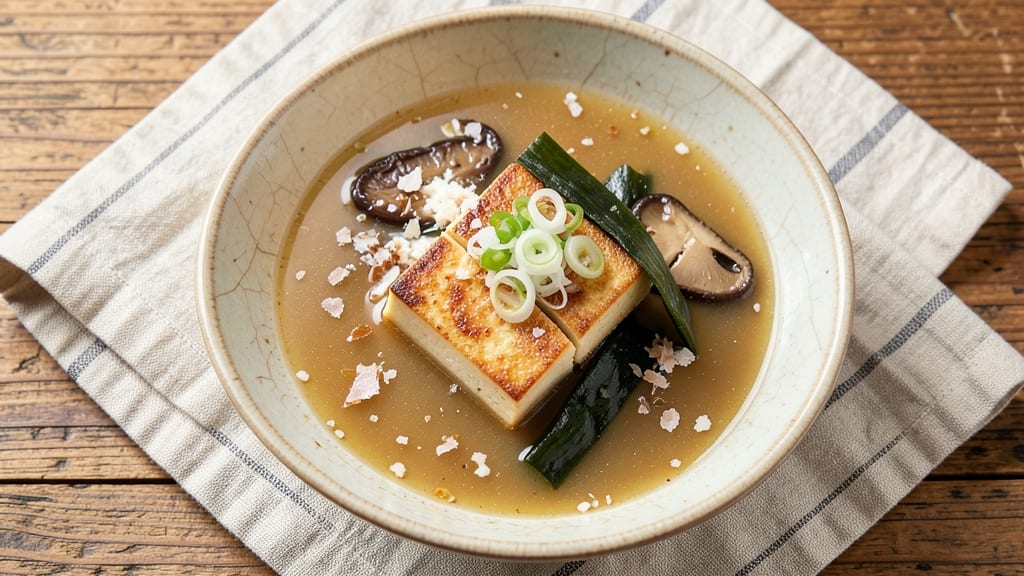
This Asian miso soup recipe delivers that perfect balance of umami depth and delicate texture—silky broth that wraps around tender tofu and fresh greens. The secret lies in slow-simmered dashi broth, where white miso paste dissolves into a velvety foundation, while crispy fried tofu adds satisfying texture.
I developed this version after years of tasting different regional styles, keeping the essence while making it approachable for home cooks.
The foundation here is a simple yet flavorful broth made with kombu and bonito flakes, which infuse the water with oceanic richness. White miso provides that gentle, fermented sweetness, while a touch of mirin brightens the flavor profile.
The tofu gets double treatment—first fried until crispy at the edges, then rehydrated in the hot broth to maintain that satisfying contrast.
What makes this recipe special is how the components come together: the first sip delivers that comforting umami warmth, while each bite offers the interplay of textures—crispy tofu, silky broth, and tender greens.
The aroma alone transforms any kitchen into a cozy Japanese izakaya, and it comes together in under 30 minutes with minimal effort.
Whether you prefer white or red miso, this recipe adapts easily—just adjust the amount for deeper color and bolder flavor. For extra depth, add a splash of soy sauce or a sprinkle of sesame seeds.
The beauty of miso soup is its versatility, making it perfect for weeknight dinners or comforting gatherings.
Ingredients for asian miso soup
Silky broth, crispy tofu, and aromatic greens—this recipe captures the essence of authentic miso soup with minimal effort.
| Ingredient | Amount | Notes |
|---|---|---|
| Extra-Firm Tofu 🥬 | 1 lb | Pressed and cubed |
| White Miso Paste 🧈 | 2 tbsp | High-quality, fermented |
| Dried Kombu 🍃 | 1 sheet | For dashi broth base |
| Bonito Flakes 🐟 | 1 tbsp | For umami depth (vegetarian-friendly) |
| Mirin 🍶 | 1 tbsp | Sweet rice wine |
| Vegetable Stock 💧 | 4 cups | Low-sodium preferred |
| Fresh Spinach 🌿 | 2 cups | Baby spinach or chopped |
| Green Onions 🧅 | 2 whole | Sliced for garnish |
| Neutral Oil 🫒 | 2 tbsp | For frying tofu (avocado or canola) |
| Sesame Seeds 🌰 | 1 tsp | Toasted for garnish |
| Diamond Crystal Kosher Salt 🧂 | ½ tsp | For seasoning broth |
| White Pepper 🌶️ | ¼ tsp | Freshly ground |
| Rice Vinegar 🍶 | 1 tsp | For brightness |
The foundation begins with dried kombu and bonito flakes—critical for that oceanic umami. Kombu should be high-quality, with a deep, seaweed aroma, while bonito flakes (ensure vegetarian-friendly) add depth. For extra authenticity, source these from Asian markets or specialty stores like H Mart—their selection is unmatched. The white miso paste must be premium; brands like Miso Master or Hessun deliver that gentle fermented sweetness without bitterness. If using red miso, reduce to 1.5 tbsp to maintain balance.
No bonito flakes? Vegetarian dashi granules (check for fish-free labels) work perfectly—just dissolve 1 tsp in the broth. For the tofu, extra-firm is non-negotiable; press it for 20 minutes to remove excess water. Swap spinach for bok choy or napa cabbage if preferred, but baby spinach keeps the delicate texture. The mirin can be replaced with 1 tsp honey or maple syrup plus 1 tsp rice vinegar for brightness, though mirin’s acidity is ideal. For a richer broth, add 1 tsp soy sauce (ensure vegetarian-friendly).
Store leftover broth in an airtight container for up to 5 days—it only gets better as flavors meld. Tofu reheats beautifully; toss it back in the broth for 2 minutes to restore crispiness. Garnish with toasted sesame seeds and green onions right before serving to preserve freshness. Freeze broth in ice cube trays for quick future batches. The crispy tofu loses texture when reheated—best enjoyed fresh, but the broth’s versatility makes it a pantry staple for 1 week or 3 months frozen.
Why You'll Love This Recipe
- No-Fuss Simplicity: I swear by this recipe when I’m too tired to fuss—just cube the tofu, soak the kombu, and let the miso do the magic. No chopping, no straining, no stress. That crispy tofu edge happens while you’re boiling water.
- Umami Bomb: The combo of white miso, kombu, and bonito flakes? Chef’s kiss. The soup starts with a deep, savory base, then hits you with that salty-sweet mirin finish. It’s the kind of flavor that makes you want to slurp it straight from the bowl.
- Meal Prep MVP: Make a big batch on Sunday—it keeps well for days, and reheating is just about adding hot water. Pack it for lunches, serve it at potlucks, or freeze portions for those nights when takeout feels like too much effort.
- Budget-Friendly Powerhouse: Tofu and miso are dirt cheap, and kombu lasts forever. I’ve made this soup for under $2 per serving, and it still feels like a fancy restaurant dish. Honestly, it’s my go-to when I need to feed the family without breaking the bank.
Step-by-step instructions for Asian miso soup with crispy tofu
Master this balance of textures and flavors—silky broth, crispy tofu, and vibrant greens.
Prepare and Press the Extra-Firm Tofu
Begin by pressing the 1 lb extra-firm tofu to remove excess moisture, which is essential for achieving that perfect crispy texture. Wrap the tofu block in a clean kitchen towel or paper towels, then place it on a plate. Set a heavy object like a cast-iron skillet or a stack of books on top. Let it press for at least 30 minutes, or up to 2 hours for maximum crispiness.
After pressing, unwrap the tofu and carefully slice it into ½-inch cubes. The tofu should feel firm to the touch—if it's still too soft, press it for another 15 minutes. This step ensures your tofu will develop a satisfying crunch rather than absorbing oil like a sponge.
Create the Umami-Rich Broth Base
In a medium saucepan, combine the 4 cups vegetable stock, 1 sheet dried kombu, and 1 tbsp bonito flakes. Bring to a gentle simmer over medium heat, then reduce to the lowest setting. Let it steep for 15 minutes—this allows the kombu and bonito to infuse the broth with deep, savory notes. Avoid boiling, as this can make the broth bitter.
Once steeped, strain the broth through a fine-mesh sieve into a clean pot, discarding the kombu and bonito. Return the broth to medium-low heat and stir in the 2 tbsp white miso paste, 1 tbsp mirin, 0.5 tsp diamond crystal kosher salt, and 0.25 tsp white pepper. Bring just to a simmer, then immediately reduce heat to maintain a gentle warmth—this prevents the miso from breaking down and losing its complexity.
Fry the Tofu to Crispy Perfection
Heat 2 tbsp neutral oil in a nonstick skillet over medium-high heat until shimmering. Add the pressed tofu cubes in a single layer, ensuring they don’t overlap. Cook undisturbed for 3-4 minutes until the bottoms turn deep golden brown—this is your cue to flip. Repeat for the other side, cooking another 3-4 minutes until evenly crispy and caramelized.
Transfer the fried tofu to a paper towel-lined plate to drain excess oil. The tofu should hold its shape and have a satisfying crunch—if it feels too soft, fry for an additional 1-2 minutes per side. Pro tip: Don’t overcrowd the pan, or the tofu will steam instead of crisp.
Assemble and Finish the Soup
Return the broth to a gentle simmer, then add the 2 cups fresh spinach and 2 whole green onions, sliced into ½-inch pieces. Let the greens wilt for 1-2 minutes, stirring occasionally. Remove from heat and stir in 1 tsp rice vinegar for brightness. Taste and adjust seasoning—you may need a pinch more salt or pepper to balance the flavors.
Divide the soup among bowls, topping each with the crispy tofu cubes. Sprinkle with 1 tsp toasted sesame seeds just before serving. The contrast of silky broth, crispy tofu, and tender greens makes every spoonful a harmonious bite. Serve immediately while the tofu is still crisp.
Pro Tips For Making Asian Miso Soup
- SOAK KOMBU FIRST: Dried kombu strips need 10 minutes in cold water before adding to hot broth—this softens them and unlocks their umami. Skip this, and you’ll end up with chewy, underwhelming seaweed that tastes like nothing.
- CUT TOFU INSTEAD OF CRUMBLING: Slice extra-firm tofu into ½-inch cubes or thin slabs—it holds shape better than crumbled pieces, which turn to mush. If you’re impatient, press it for 15 minutes first, but even then, cubes stay intact longer.
- STIR MISO LAST: Add white miso paste only after the kombu and tofu have simmered for 2–3 minutes—this prevents bitterness from overcooking. Stir it in gently; aggressive mixing can turn your soup cloudy.
- USE MIRIN SPARINGLY: A splash (1–2 teaspoons) brightens the broth, but too much makes it cloyingly sweet. Taste after adding, and adjust with a pinch of salt if needed—mirin’s sugar can overpower the miso’s depth.
Essential equipment for great asian miso soup
Broth Simmering Pot
Your broth is the soul of this soup, so a stainless steel saucepan is my top recommendation—it distributes heat evenly and prevents scorching. I use a 3-quart Farberware Classic Stainless Steel Saucepan because its sloped sides make stirring easier, and the tight-fitting lid helps maintain gentle simmering.
For budget-friendly options, Cuisinart MultiClad or Cuisinart Stainless Steel Saucepan (1.5-2 quart size) work perfectly. Avoid nonstick pans for broth—they can impart off-flavors when simmering kombu and miso. 🌡️
Fine-Mesh Sieve
A dedicated fine-mesh sieve is essential for straining kombu and bonito flakes without losing precious broth. I swear by the OXO Good Grips Strainer—its durable mesh and ergonomic handle make it a kitchen workhorse. For smaller batches, the EZFoffy Collapsible Strainer is a space-saving alternative.
Pro tip: Rinse your sieve thoroughly after use to prevent miso residue buildup, which can affect future batches. The cleaner your tools, the purer your broth.
Nonstick Skillet
For that perfect crispy tofu, a nonstick skillet with an even heating surface is non-negotiable. My go-to is the All-Clad Stainless Steel Nonstick Skillet—it handles high heat beautifully and releases tofu without sticking. Budget pick: Cuisinart Chef’s Classic Nonstick Skillet (10-inch) delivers professional results without the premium price.
Avoid cast iron for this step, as it can make tofu too greasy. A heat-resistant silicone spatula helps flip those delicate cubes without tearing.
Tofu Press
While you can DIY with towels and books, a dedicated tofu press saves time and ensures consistent results. The Norpro Tofu Press is my favorite—its adjustable pressure and compact design fit any kitchen. For minimalists, the OXO Good Grips Tofu Press offers a simpler, more affordable option.
Pressing is critical: under-pressed tofu absorbs oil like a sponge, while over-pressed tofu crumbles. Aim for 30-60 minutes depending on your tofu's firmness. 💪
Digital Thermometer
While not strictly necessary, a digital instant-read thermometer helps perfect your broth temperature. I use the ThermoWorks ThermoPop to confirm broth reaches 195-205°F—the ideal range for dissolving miso without breaking it down. For simmering, maintain 185-190°F to keep flavors intact.
This tool is especially helpful when adapting recipes with different miso types (red vs. white) or when troubleshooting bitter broth. The Thermoworks Smoke is another excellent option for more advanced monitoring.
Storage Containers
For leftovers, glass airtight containers preserve flavor and texture best. I recommend Pyrex Simply Store containers—their wide mouths make assembly easy, and the glass won’t absorb odors. For broth freezing, quart-sized silicone ice cube trays are perfect for portion control.
Label everything with dates, as miso soup broth improves with age but should be consumed within 5 days refrigerated or 3 months frozen. Pro tip: Leave 1-inch headspace in containers to prevent freezer burn from expanding liquid. ❄️
Nutrition facts
Frequently asked questions
What's the difference between white and red miso in this recipe?
White miso offers a gentle, sweet fermented flavor perfect for delicate soups, while red miso delivers a deeper, richer umami with a slightly tangy bite. For this recipe, white miso is ideal—it creates a smooth, balanced broth. If using red miso, reduce to 1.5 tbsp and add ½ tsp extra mirin to soften its intensity.
Can I make this soup vegetarian?
Skip the bonito flakes and use vegetarian dashi granules (check labels) or substitute with ½ cup dried shiitake mushrooms simmered in the broth for depth. For extra umami, add 1 tsp soy sauce or a splash of vegetable-based fish-free dashi powder.
Why did my tofu turn out soggy instead of crispy?
Soggy tofu usually means insufficient pressing or overcrowding in the pan. Press for at least 30 minutes (longer for extra-firm tofu) and fry in a single layer over medium-high heat until golden brown. Use a nonstick skillet and avoid flipping too soon—wait for a deep golden crust.
How can I make this soup spicier?
Add a pinch of red pepper flakes or a dash of gochujang (Korean chili paste) to the broth. For heat with depth, stir in ½ tsp grated fresh ginger while simmering. Garnish with sliced chili threads or a sprinkle of sriracha before serving for extra kick.
Can I prepare the broth ahead of time?
Yes! The broth actually improves with time. Store it in an airtight container in the fridge for up to 5 days or freeze for 3 months. When reheating, warm gently on low heat—never boil—to preserve flavor. Add fresh tofu and greens just before serving for the best texture.